
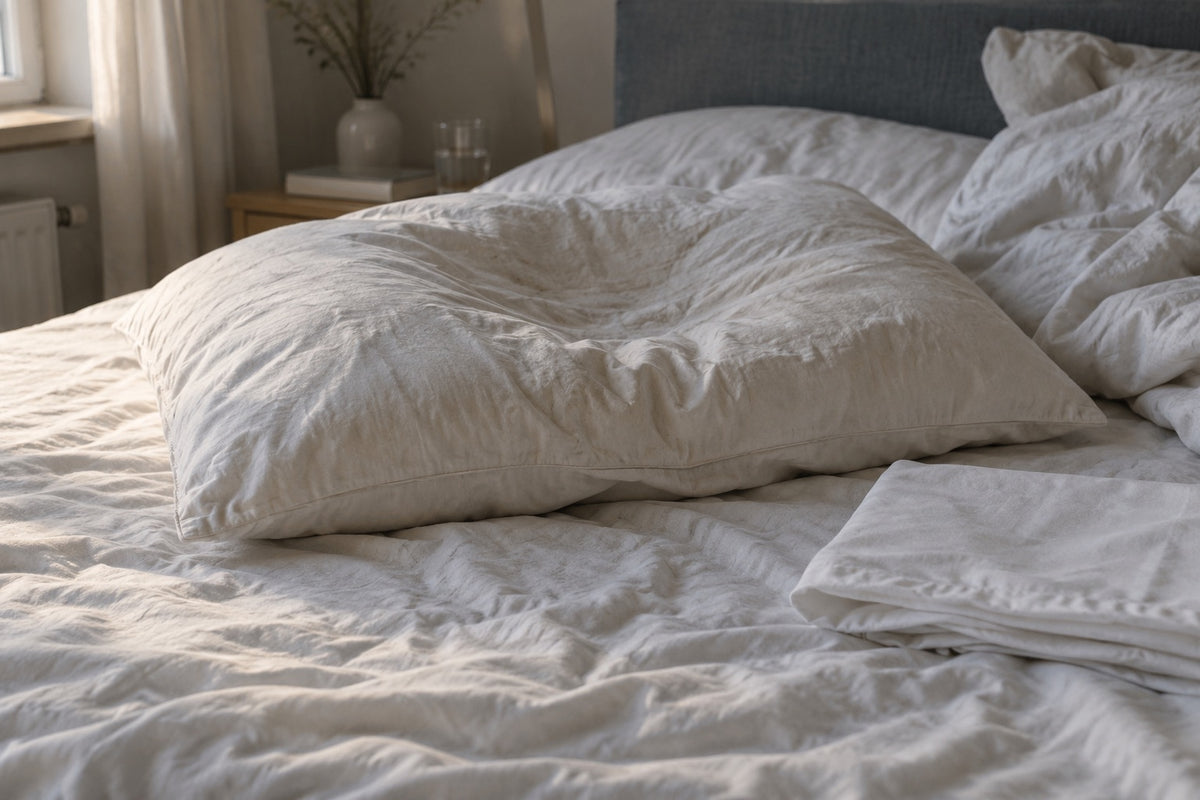
In short: A pillow isn't finished when it reaches a certain age, but when it no longer holds the height you bought it for. With fiber and down pillows, that often happens after one to three years; with viscoelastic (memory) foam, after two to four; with dense cold-cure foam and latex, after five to eight. You can check it: measure the height, test the recovery, look for a dent. The second question is hygiene – and that mainly concerns the cover, not the core.
When is a pillow “worn out”?
The usual advice – “replace it every two years” – dates from a time when pillows were made of feathers or fiber and really did go flat within that time. For a shaped foam pillow, the question is a different one: does it still have the height and shape it was designed for?
Stiftung Warentest, Germany's consumer testing foundation, measures exactly that in its neck pillow test: the firmness before and after an endurance test with a stamp that simulates thousands of nights. A pillow that is noticeably softer afterward will also have noticeably less height after two years at your place. Age is only a proxy for this measurement – and a poor one, because different materials age differently.
How long do the materials last?
| Material | Typical lifespan of support | Signs it's reached the end |
|---|---|---|
| Fiber / polyester | 1–2 years | Clumps, permanently flat, can no longer be fluffed up |
| Down / feathers | 2–3 years (down), 3–5 years (feathers) | Fill power gone, pillow stays flat after fluffing, quills poke through |
| Viscoelastic foam (memory foam) | 2–4 years | Permanent dent in the center, no longer returns to shape by morning, crumbly at the edges |
| Latex | 5–8 years | Becomes brittle or sticky, loses elasticity, yellowish discoloration in natural latex |
| Cold-cure foam, high density | 5–8 years | Softer than at the start, dent stays visible after the hand test |
| Natural fillings (spelt, millet) | 2–4 years | Husks crumble, filling gets dusty, volume decreases |
These ranges are based on experience, not standards. What counts is the test.
How do you check whether your pillow still holds its height?
Three checks, five minutes in total:
- The hand test. Press your flat hand firmly into the center for five seconds, then let go. An elastic foam or latex fully springs back within a few seconds. If a visible dent remains for longer than half a minute, the material is worn out. With viscoelastic foam, a slow return is normal; a permanent dent is not.
- The height comparison. Measure the height at the center of the pillow, without any load, in the evening after fluffing it up. Compare it with the height at the edge or with the manufacturer's specification. Two centimeters of difference between center and edge on a pillow that was even when new are two centimeters your neck is missing.
- The morning test. When you wake up, look at the pillow before you touch it. A pillow that holds its shape looks the same in the morning as it did in the evening. A worn-out one has a head cradle that isn't part of its design.
A fourth sign is indirect: if you suddenly find yourself folding a pillow that fit for years in half, or putting your hand under it, it's not your neck that has changed – the pillow has gotten flatter.
What about hygiene – dust mites, sweat, skin flakes?
Every night, a pillow absorbs sweat and skin flakes; dust mites feed on the latter. That's one reason why older pillows can make allergies worse. But most of it ends up in the cover and the pillowcase, not in the core – especially with closed foam or latex, which mites have difficulty penetrating.
That sets the order of care: wash the pillowcase weekly with your bed linen. Wash the inner cover, if removable, every one to three months at the temperature stated on the label. Air the core regularly – unwrapped, in the open air, but not in direct sunlight, which ages foam and latex. For allergy sufferers, covers that can be washed at 60 °C are the effective lever; the core itself doesn't need to be replaced for that.
Can you wash foam pillows?
The core doesn't go in the machine. Viscoelastic foam, cold-cure foam and latex absorb water, dry very slowly and can tear, grow mold or lose their structure in the process. What works:
- Dab stains on the core locally with a damp cloth and a little mild detergent – don't rub, don't soak.
- Then let it dry flat in a well-ventilated spot, without a radiator or hair dryer, until the core is completely dry – this can take a day.
- Wash all covers according to the label; only air the core.
Down and fiber pillows are usually machine-washable, but lose some fill power with every wash. Natural fillings such as spelt must not get wet.
How do you care for the hana pillow?
You can take the cover off and wash it; the temperature is on the label. Don’t wash the blue foam core: it doesn’t go in the washing machine and shouldn’t get wet. Any regular 50 × 70 cm pillowcase fits over it. Because the core is a high-density foam, it keeps its shape for years. More answers are in our FAQ.
And if your old pillow never fit?
Answer a few questions about how you sleep and how you are built – with a side photo if you like. From them we calculate your pillow core with its neck-roll height, head cradle and edge angle. Made in Switzerland, with you in about 1 week. 100-night trial.
Frequently asked questions
How often should you replace a pillow?
Not by the calendar, but by its condition: when it no longer holds its height. For fiber and down pillows, that's usually after one to three years; for memory foam, after two to four; for latex and dense cold-cure foam, after five to eight.
How can I tell that my pillow is worn out?
A permanent dent in the center, a clear height difference between center and edge, no return to shape after the hand test – or if you suddenly find yourself folding it or putting your hand underneath.
Can you wash a foam pillow?
Not the core in the machine; it absorbs water, dries poorly and can tear or grow mold. Spot-clean it with a damp cloth and let it dry completely. Wash the covers according to the label.
How long does a neck support pillow last?
Two to eight years, depending on the material. What matters is whether the neck roll and head cradle still have their original height – the hand test and the height comparison will tell you.
Can an old pillow trigger allergies?
It can make them worse, because skin flakes and dust mites accumulate – mainly in the cover and pillowcase. Washing at 60 °C and airing the core regularly are the most effective levers; if symptoms persist, it's worth seeing a doctor.
Sources
- Stiftung Warentest. Nackenkissen im Test. test 9/2025 (test method: firmness measured before and after the endurance test, washability of the covers).
- Schweizer Institut für Qualitätstests (SIQT). Kopfkissen im Einzeltest: durability testing with firmness and height measurement after sustained loading (2024).
- US patents on viscoelastic polyurethane foam (including US 11,401,366): aging of viscoelasticity at low density.


