
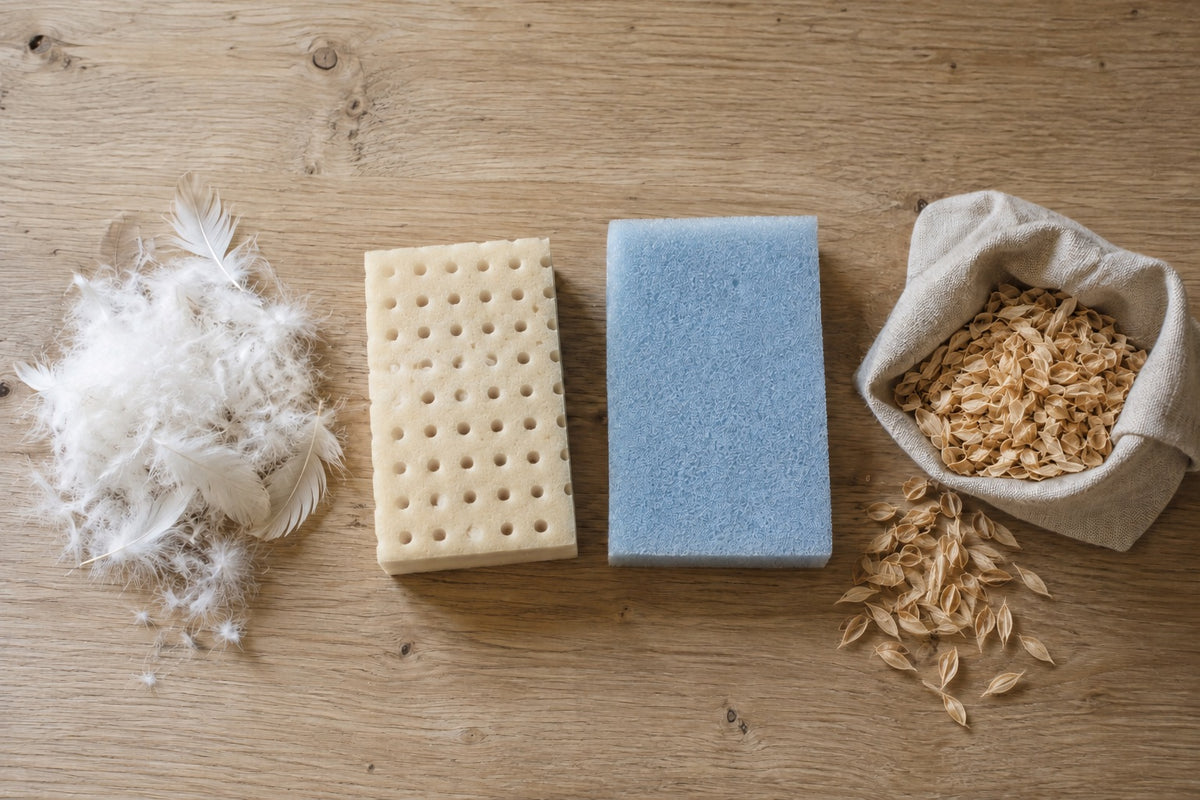
In short: No material makes a pillow fit. What makes it fit is height and shape. After that, the material decides a single question: is the height that feels right when you lie down still the same at 2 a.m., and still the same in January? Down keeps losing height under the weight of your head. Viscoelastic (memory) foam gets softer with body heat and harder in a cold bedroom, because its glass transition temperature sits close to room temperature. Latex and open-cell cold-cure foam hold their height most consistently. So the material question is really a question of shape stability.
Why is material the wrong first question?
Most buying guides start with the filling: down for coziness, memory foam for support, latex for allergy sufferers. That's the order of the store shelf, not the order of your neck.
Your neck doesn't feel a filling. It feels a height and a shape: how high your head sits, and how far your cervical spine is tilted out of its neutral line. EMG measurements show the lowest neck-muscle activity at the height derived from body geometry – regardless of material. A 2021 meta-analysis did find a small advantage for latex pillows. But the obvious explanation isn't some magic in the material; it's that latex holds its height, while down and soft foams lose it over the course of the night.
So the first question is: what height and shape do you need? That's covered in our article on the right pillow height. The second question, and the one this article is about: which material delivers that height reliably – not just in the store, but after three hours, at a bedroom temperature of 17 °C, after two years?
What does “shape-stable” mean for a pillow?
Three things, each of which has to be checked separately:
- Give under load. How much height does the pillow lose when five kilograms of head rest on it? With down, it's several centimeters; with a supportive foam, one to two; with latex, similar depending on density, but elastic rather than permanent.
- Creep over the night. Does the height stay stable after the initial sink, or does it keep dropping? Down and loose fillings shift. Viscoelastic foam keeps sinking slowly as it warms up.
- Recovery and aging. Does the pillow return to its shape in the morning? And does it still do so after 700 nights? Stiftung Warentest, Germany's consumer testing foundation, measures this in its endurance test as a change in firmness – more on that in our article on how long a pillow lasts.
A pillow that is stable on all three counts has the same height at 2 a.m. as when you lay down. Only then is the height you measured or chose also the height you actually sleep on.
Why does memory foam behave differently in winter and summer?
Viscoelastic foam is a polyurethane foam whose glass transition temperature – the range in which the material changes from hard and glassy to soft and rubbery – is deliberately set close to the temperature of use, typically between 20 and 30 °C. That is exactly what creates the familiar effect: the foam softens under your warm head and gives way slowly, but only returns sluggishly. The “memory” is the sluggishness.
The side effect: a foam whose properties change sharply between 20 and 30 °C also changes with your bedroom. At 16 °C in winter it is noticeably harder; the pillow feels higher and barely gives. At 26 °C in summer it is softer, sinks deeper and feels flatter. The manufacturers of these foams describe this in their own patents as a drawback to be mitigated with additives – with varying success.
For height, this means a memory foam pillow doesn't have one height but a range, depending on the season and the heating. If you sleep well on such a pillow in summer and badly in winter, you probably don't have a neck problem but a temperature problem. On top of that, the more closed cell structure many viscoelastic foams need for their sluggishness retains heat and moisture – which is why these pillows are often perceived as warm.
How do the materials compare?
| Material | Give under load | Stable through the night | Temperature-dependent | Recovery / aging | Climate |
|---|---|---|---|---|---|
| Down / feathers | High, several cm | No – shifts, needs to be fluffed up | Hardly | Good as long as the fill power lasts; down wears out after 2–3 years | Warm, prone to moisture |
| Viscoelastic foam (memory foam) | Medium, increases with warmth | Partly – keeps sinking slowly when warm | Yes, markedly (glass transition 20–30 °C) | Sluggish; loses support over the years | Rather warm, depending on cell structure |
| Latex (natural or synthetic) | Medium, elastic | Yes | Low | Very good, but heavy; natural latex can become brittle over time | Neutral, open-cell |
| Cold-cure foam / open-cell PU foam | Low to medium, depending on density | Yes | Low | Good at high density | Cool, breathable |
| Natural fillings (spelt, millet, buckwheat) | Moldable | Partly – filling migrates | No | Good, but noisy and heavy | Cool |
| Fiber / polyester | High | No – clumps and flattens | No | Poor; usually flat after a year | Neutral |
Two materials hold their height reliably: latex and dense, open-cell cold-cure foam. Both are elastic rather than sluggish, spring back into shape immediately and barely react to room temperature. The difference between them is weight and climate: latex is heavy and denser, cold-cure foam lighter and more breathable.
Why did hana choose this foam?
Because with hana, the shape is the product. Your pillow core is cut with its neck-roll height, head cradle and edge angle to within 3 mm. That shape only helps if it stays the same all night and all year. That sets four requirements for the material:
- Shape-stable, not temperature-dependent. The core is a high-resilience, open-cell foam. It keeps the neck roll and head cradle the same at 16 °C in winter as at 26 °C in summer. Memory foam would get harder or softer with the room temperature – and so feel higher or flatter.
- Elastic, not sluggish. The foam gives under your head and is back in shape the moment you turn over at night. Memory foam takes a few seconds for that – seconds in which your head lies in the old hollow.
- Precisely cuttable. An even foam with a high density can be cut to shape to the millimeter and keeps that shape for years. Down and fiber fillings have no fixed shape that could be cut at all.
- Airy and light. The open-cell structure and the ventilation channels in the core let air circulate, so the pillow traps less heat. Latex would hold the height similarly well, but it is much heavier and denser.
The core carries the shape; the cover takes care of how it feels on your skin: the core sits in a soft, fluffy TENCEL™ cover that feels cool and smooth.
We don’t give the foam a made-up name. It is open-cell polyurethane foam with a high density – not an invention, just the right choice for a pillow whose shape shouldn’t waver.
How can you tell if your pillow holds its height?
Press your flat hand firmly into the center of the pillow for five seconds, then let go. If it fully springs back within two or three seconds, it's elastic. If the imprint stays visible for ten seconds or longer, it's viscoelastic – and temperature-dependent. If a dent remains, the material is worn out.
The second test takes one night: measure the height of the pillow in the evening and in the morning, before you fluff it up. The difference is the height you lost overnight.
Which material is right for you?
Answer a few questions about how you sleep and how you are built – with a side photo if you like. From them we calculate your pillow core with its neck-roll height, head cradle and edge angle. Made in Switzerland, with you in about 1 week. 100-night trial.
Frequently asked questions
Is memory foam good for your neck?
Only if the height is right – and with viscoelastic foam, that height changes with temperature. In a cold room it gets harder and feels higher; in a warm one, softer and flatter. If you have a memory foam pillow that fits in summer but not in winter, this is exactly what you're experiencing.
Which is better: latex or memory foam?
Latex holds its height and shape more consistently through the night and across the seasons, because it is elastic rather than sluggish. In a 2021 meta-analysis, latex pillows performed slightly better for neck pain. Memory foam conforms more closely, but is temperature-dependent and warmer.
Are down pillows bad for your neck?
Down doesn't hold height: under your head it sinks several centimeters and shifts. For side sleepers, the support is therefore usually not enough; for stomach sleepers, who need a very flat pillow, it can be just right.
What is cold-cure foam, and is it better than memory foam?
Cold-cure foam is an open-cell, high-resilience polyurethane foam that is cured without added heat. It springs back into shape immediately, is breathable and barely temperature-dependent. For a pillow with a fixed geometry, it is more stable than viscoelastic foam.
Why does my memory foam pillow get hard in winter?
Because the glass transition temperature of these foams lies between roughly 20 and 30 °C. Below that range, the material stiffens. In a bedroom at 16 to 18 °C, the pillow is therefore noticeably harder than in summer.
Sources
- Pang J.C.Y. et al. The effects of pillow designs on neck pain, waking symptoms, neck disability, sleep quality and spinal alignment in adults: a systematic review and meta-analysis. Clinical Biomechanics 85:105353 (2021).
- Radwan A. et al. Effect of different pillow designs on promoting sleep comfort, quality, & spinal alignment: a systematic review. European Journal of Integrative Medicine 42 (2021).
- The impact of pillow height on neck muscle activity: a pilot study. Sleep and Breathing (2024). doi:10.1007/s11325-024-03219-6
- US patents on viscoelastic polyurethane foam (including US 11,401,366; US 11,518,842; US 12,060,506): description of the glass transition temperature of 20–30 °C and the resulting temperature dependence of firmness.
- Stiftung Warentest. Nackenkissen im Test. test 9/2025 (test method: firmness measured before and after the endurance test).


